We use cookies to make your experience better. To comply with the new e-Privacy directive, we need to ask for your consent to set the cookies. Learn more.

In stock
Product Code
BVOCCGCP
SKU
BB1879
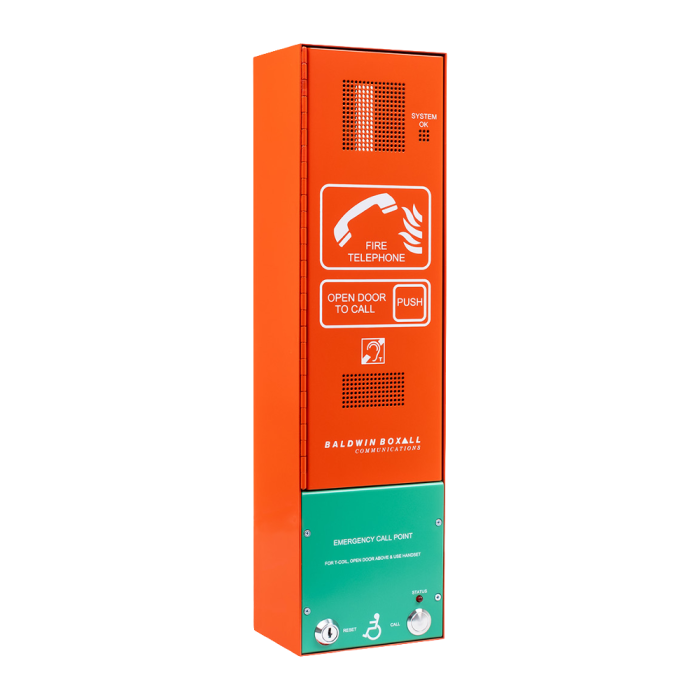
Baldwin Boxall Omnicare Combined Green Refuge Outstation & Red Fire Telephone with Push Door
Omnicare BVOCCGCP Type C Outstation Red/Green
DELIVERY
We always aim to same day dispatch on all orders received before 2.30pm.
TRADE COUNTER
Firesense also offer the ability to collect your order from our trade counter.
Baldwin Boxall BVOCCGCP
Communication when you need it most
OmniCare EVC system is a Loop Wired Emergency Voice Communication system which features Disabled Refuge (standard and Advance options – Type B), Fire Telephone (Type A), Combined Refuge/Fire Telephone Outstation (Type C), Steward Telephone (Type A) and Emergency Assistance/Disabled Toilet Alarm facilities. Fully expandable, it enables up to 127 outstations per system.
Emergency Voice Communication (EVC) systems provide two-way communication between building management or emergency services and people inside a building who require assistance with evacuation in an emergency. Communication is made between a central location point and a number of points known as ‘outstations’ located around a building or building complex.
The OmniCare system was the first of its kind when introduced as a combined EVC system. Since then it has been installed throughout the world becoming the system of choice for many. The system includes a three-part toilet alarm kit option which, like all of the remote units, is powered from the line (no local power is required).
OmniCare provides an alternative EVC option to our popular radial-wired CARE2 EVC system.
Further Information
- The OmniCare standard system has a capacity for up to 127 outstations in total (either connected to a single control panel or on a networked system with multiple control panels).
- Touchscreen control is available and ideal for use in public/reception and lobby areas, providing full control of the OmniCare system via a bespoke button or graphical display.
- Disabled refuge, advance disabled refuge, fire telephone, emergency/steward telephone, combined DRS/fire telephone and emergency assistance/toilet alarm units can be placed on the same loop.
- Multiple Control Panels can be included on a single system (configured as a Master and Slave units).
- Control Panels, Type A, Type B and Type C outstations are supplied surface-mountable as standard and flush-mountable with separately available bezel.
- Addressable system via the outstation with speech steered (Type B Disabled Refuge) and full duplex speech (Type A Fire/Steward Telephone) communication.
- The system is fully monitored and battery backed.
- Standard battery backup provides 24 hours standby plus three hours use in the event of a mains failure as standard. Increased capacity is possible, if required. (A separate box to house batteries is supplied with panels larger than 32-way).
- Link to fire detection system prevents hoax calls from disabled refuge (toilet alarms and fire telephones remain active). Can be completely or partly overridden. Outstations are kept in ‘standby mode’ until activated. For system maintenance and testing an override switch (BVCRBG) should be connected to the system.
- Fully BS9999:2017, BS5839-9:2021 and BS8300-2:2018 compliant when installed according to the standards.
For systems that require more field devices please refer to our OmniCarePLUS solution. Or, if the OmniCare EVC System is not what you are looking for, our CARE2 Radial Wired EVC System may suit your requirements.
Features
- Self-powered from ring circuit, no local power source is required. Automatic battery backup is provided by the control panel in the event of a mains power failure.
- Addressable unit.
- Surface mount (or flush mount with optional bezel).
- All outstations are in a loop circuit from control panel(s).
Fire telephone:
- Provides two-way, full duplex, speech communication.
- The fire telephone section contains a rugged red handset with hearing aid compatible earpiece and loudspeaker.
- Calls are initiated upon opening the door. When answered, the user can talk to the operator either by lifting the handset or hands-free. Closing the door ends the call.
- Conference call facility between multiple fire telephones is available via the operator at the control panel.
Disabled refuge remote:
- Provides two-way, hands free, speech steered communication.
- Volt free contact, active when occupied. To operate over door lamps, silence speaker/sounder, etc.
- Stainless steel ‘press to call’ button.
- Calls can be reset either by of the keyswitch on the remote unit or at the master control panel.
- Option to be permanently ‘active’ if required.
- Reset from either remote unit using the key switch or via the master control panel.
| Approval | BS5839-9:2021 |
|---|---|
| Category Type | Outstation |
| Colour | Green, Red |
| System Type | Emergency Voice Communication |
| Refuge Type | Type C |
| Clearance | No |
Write Your Own Review

Specifications
| Product code (push door) | BVOCCGCP |
| Power supply | 12-40V DC self powered from ring circuit |
| Power consumption | 35mA @ 35V typical |
| Weight | 5.5 kg |
| Humidity range | 95% non-condensing |
| Temperature range | -10°C to +40°C |
| Indicators | System healthy, call status |
| Finish | RAL 2002 / RAL 6024 |
| Dimensions mm W x H x D | 130 x 480 x 100 |
| Bezel dimensions mm W x H | 170 x 520 |
| Bezel cutout mm W x H | 138 x 488 |
| Knockouts/cable entry points | 2 x 20mm top (site wiring) 2 x 20mm bottom (relay contacts from disabled remote section) |
| Mounting position | Centre of fire telephone section should be at a height of 1.3-1.4m (disabled refuge section centre at 1.1-1.2m). |